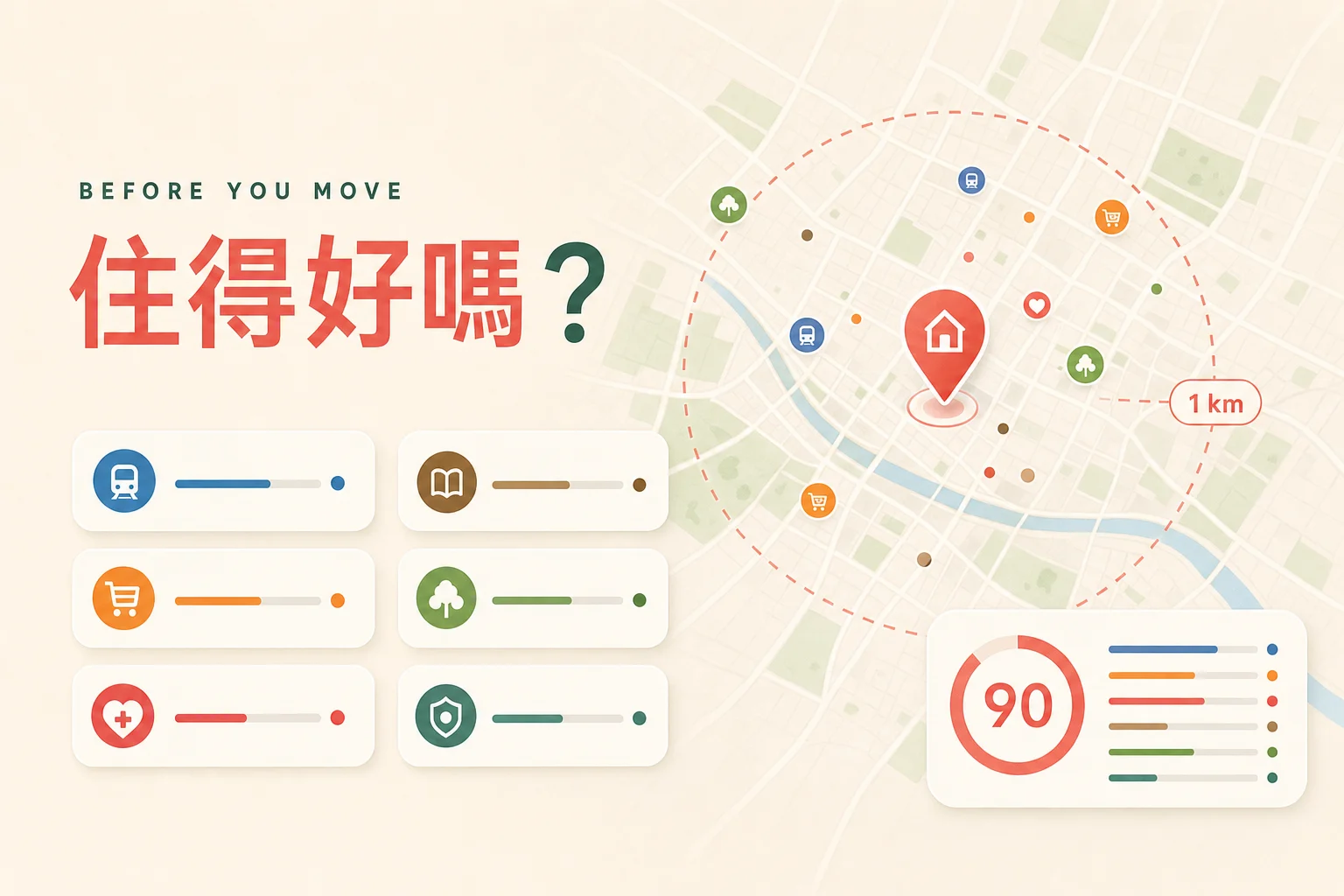
Before You Move, See What Life at This Address Might Actually Be Like
When looking for a place to live, we usually start with the rent, floor area, building age, and photos.
But once you actually move in, your daily life is often shaped by a different set of questions: Can you walk somewhere to buy dinner? Is there a clinic nearby? Is commuting convenient? Does the area flood during heavy rain? And when you come home alone at night, does the neighborhood feel safe?
This information exists, but it is scattered across different websites, maps, and government datasets. Evaluating a single address often means opening multiple tabs, and even then, it can still be difficult to form a complete picture.
That is why I created “Is It a Good Place to Live? Taiwan Neighborhood Livability Assessment.”
It is a neighborhood assessment tool built around a specific address. Its goal is to help people answer one practical question before viewing a home, signing a lease, or moving:
Would this place fit the way I live every day?
Look Beyond the Home and Understand the Neighborhood Around It
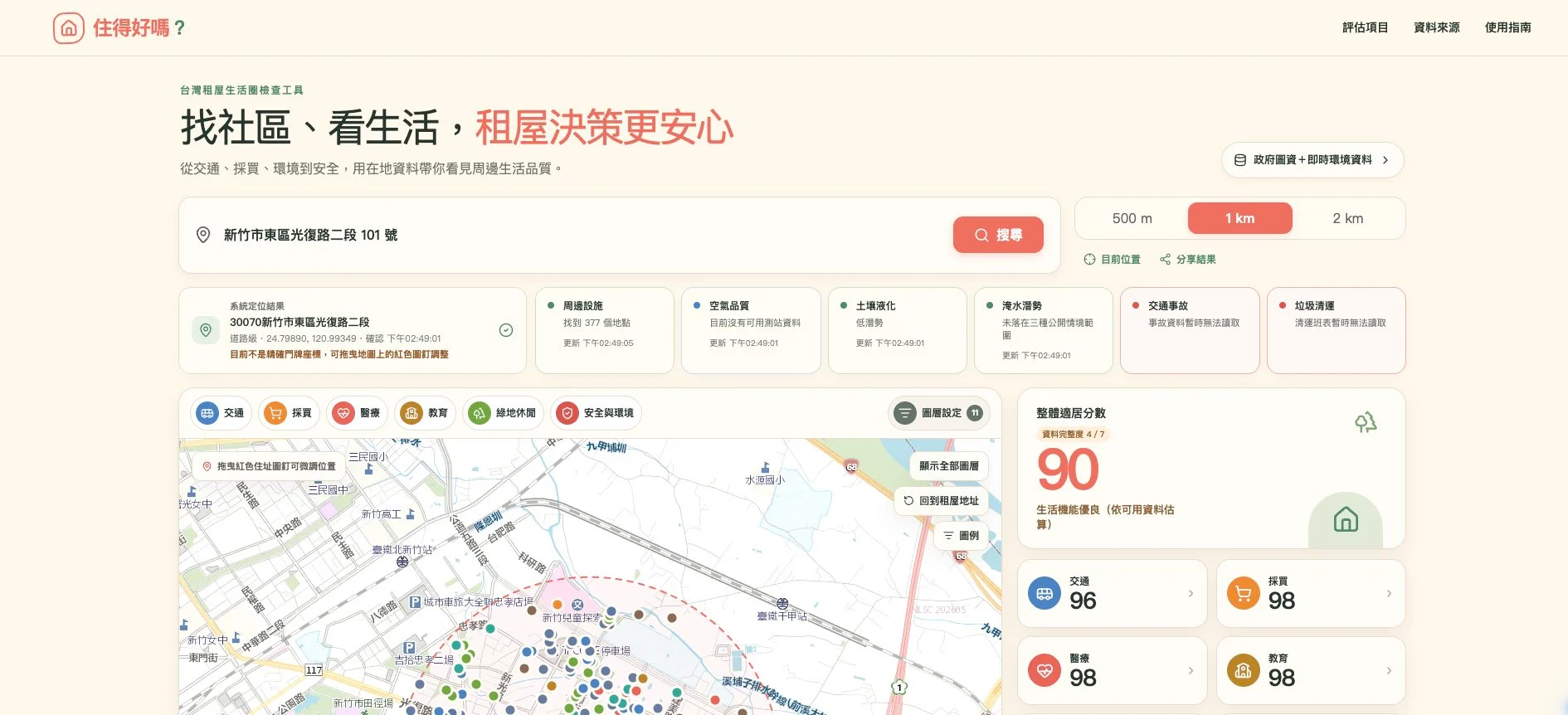
Using the website is simple. Enter an address, choose a radius of 500 meters, 1 kilometer, or 2 kilometers, and the site will organize nearby information on a single map.
The current assessment covers:
- Transportation: How convenient commuting and everyday travel might be
- Shopping and dining: Whether daily necessities, shops, and food options are readily available
- Healthcare: Access to clinics and other medical services
- Education: The distribution of schools and related facilities
- Green spaces and recreation: How easily parks and leisure spaces can be reached
- Safety and environment: Information about air quality, flood risk, soil liquefaction, traffic accidents, garbage collection, and other local conditions
You can switch between map layers to see where facilities and potential risks are located. You can also adjust the weighting of each category so that the assessment better reflects your own priorities.
For example, a family with children may care more about schools, healthcare, and parks. Someone who commutes by public transportation every day may place transportation first. A remote worker may care more about shopping convenience, environmental quality, and whether there are pleasant places to walk nearby.
The same address should not have only one standard answer for everyone.
The Score Is a Starting Point, Not a Final Verdict
The website uses currently available data to generate an overall neighborhood livability score. However, the score is not meant to decide whether you should or should not live there. It is designed to help you quickly identify areas that deserve a closer look.
For example, an area may receive a strong overall score while still showing flood risk on the map. Another address may not have many shops nearby, but it could be within easy reach of a park, school, and clinic.
What matters more than the score itself is whether you can see the information behind it and understand how that information relates to your own lifestyle.
The website also identifies data that is currently unavailable. When information is incomplete, the result is calculated only from the available categories. Missing data is not treated as proof that no risk exists.
This is an important principle when using any tool based on open government data.
How I Would Use It When Comparing Homes
When comparing several rental addresses, I would first set the same search radius for each one, such as 1 kilometer, and then review the following:
- Whether my usual commuting method is convenient.
- Whether commonly used shops, medical services, and recreational facilities are within walking distance.
- Whether the area shows warning signs related to flooding, soil liquefaction, or traffic accidents.
- How the results change after adjusting the category weights based on my own priorities.
- Which points should be written down and checked in person during the viewing.
The tool cannot replace visiting a property in person. Noise, natural light, neighbors, the walkability of sidewalks and covered walkways, and the actual feeling of the neighborhood at night still need to be experienced firsthand.
However, it can help you prepare before you go, so that your limited viewing time can be spent asking better questions and checking the details that matter most.
Turn House Hunting from “Viewing a Property” into “Understanding a Way of Life”
Choosing a place to live is really about choosing the roads you will travel every day, the shops you will visit regularly, the places where you can take a walk, and the resources you can rely on when something unexpected happens.
“Is It a Good Place to Live?” aims to bring scattered neighborhood information back onto a single map, so that renting and moving decisions do not have to rely only on property photos, advertising copy, or vague impressions.
If you are currently looking for a home, considering a move, or simply curious about how your current neighborhood performs, try entering a familiar address:
👉 Is It a Good Place to Live? Taiwan Neighborhood Livability Assessment
Feel free to share the assessment with friends who are also looking for a place to live. I hope it helps you open fewer tabs and notice more of the details that genuinely shape everyday life.